
NEED HELP WITH YOUR PROJECT?
CALL US: 877.301.7800
EMAIL US: support@cleanfi.com
When two financing mechanisms work better together
Some solar and battery-storage projects have strong economics but a financing gap that prevents them from moving into construction.
Consider these two common scenarios:
- A private company has a solar and/or battery-storage project valued at less than $2 million. The company cannot absorb all of the project’s Investment Tax Credit in the first year, but it needs some immediate value from that tax credit to make the construction financing work.
- A nonprofit owns the property where the project will be installed. It may qualify for Elective Pay, also known as Direct Pay, but it does not want to fund the entire project, complete the IRS pre-filing registration process, file the required tax forms, and wait until after the project has been placed in service to receive the benefit. It may also lack enough real-estate equity to finance the entire project through C-PACE alone.
In both situations, neither a Solar Power Agreement nor a C-PACE assessment may provide the complete solution by itself.
Together, however, they can create a particularly effective capital stack.
Begin with the Solar Power Agreement
A Solar Power Agreement, or SPA, is CleanFi’s generic term for a third-party-owned solar and/or battery-storage structure designed to provide immediate and predictable value from a project’s tax benefits.
Under the SPA:
- A sponsoring investor becomes the owner-operator of the solar or storage system for an agreed period.
- The investor contributes a fixed amount toward the project cost based on the tax benefits and other economic value it expects to receive.
- The property owner or off-taker contributes—or finances—the balance required to complete the project.
- The agreement provides a legally structured path for the system to pass to the property owner relatively early in the agreement, without requiring the traditional Fair-Market-Value buyout associated with many Power Purchase Agreements.
For smaller projects, the SPA can offer several advantages over attempting to sell the tax credit through the open Transferability market:
- A predictable contribution amount.
- Faster and less document-intensive underwriting.
- A much lower minimum tax-credit value.
- No need for the property owner to wait for an unknown tax-credit buyer.
- A defined path toward eventual ownership of the equipment.
These characteristics make the SPA particularly useful for the sub-$2 million projects discussed in Four Paths to ITC Liquidity for Sub-$1M Values.
But the SPA does not ordinarily fund the entire project. The property owner still needs to provide or finance the balance.
That is where the problem usually begins.
Why most equipment loans and capital leases conflict with an SPA
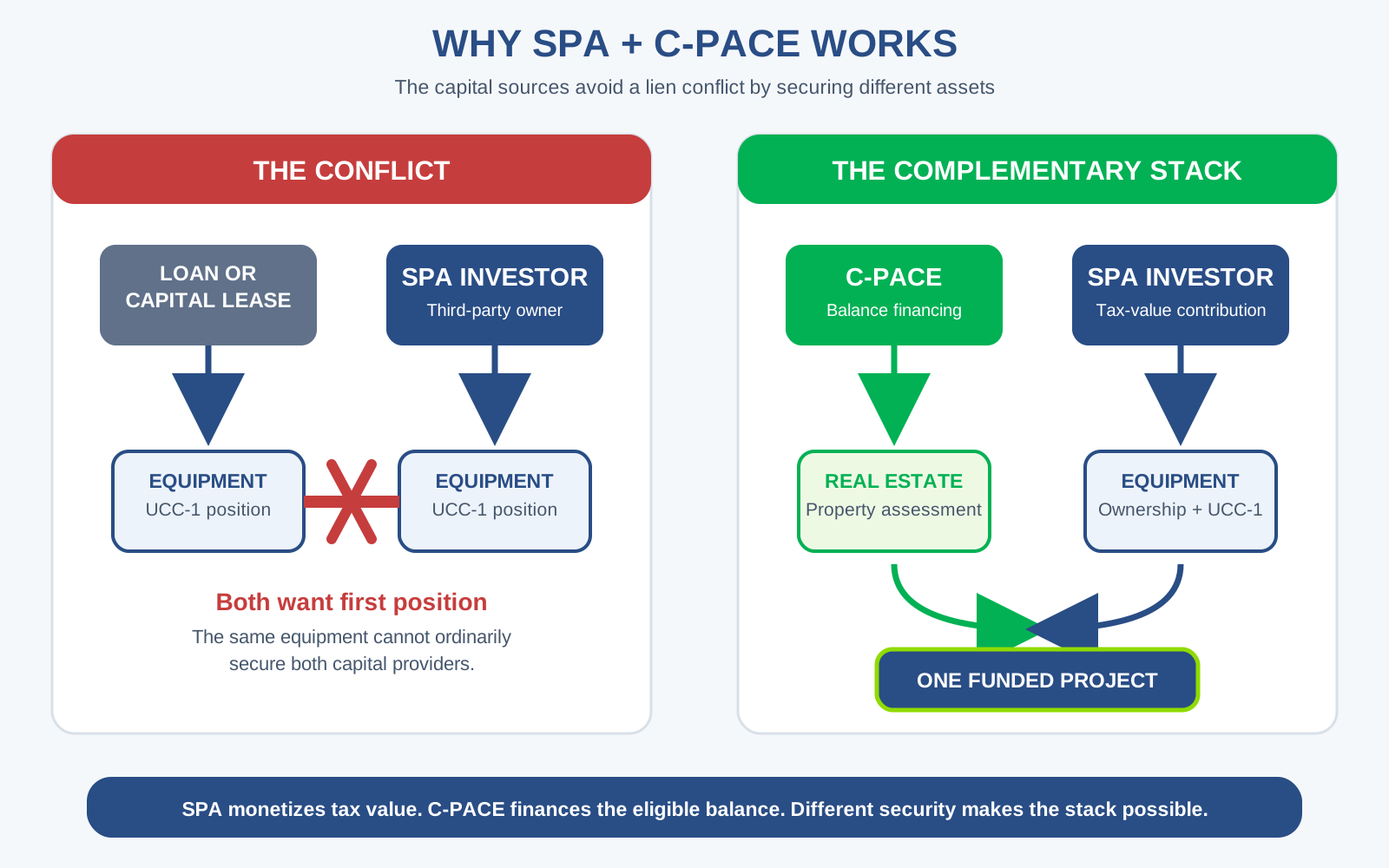
The SPA investor owns the solar or battery-storage system and generally protects that ownership interest by filing a UCC-1 against the equipment.
Most loans and capital leases used to finance solar and storage equipment also require a UCC-1 lien against that same equipment.
Both capital providers want first position.
The SPA investor cannot reasonably accept another lender’s prior claim against equipment that the SPA investor owns. The lender or capital-lessor, in turn, will usually not finance equipment if another party already has the first right to repossess it.
The problem is therefore not necessarily the loan or lease itself. The problem is the collateral.
As explained in How Different Financing Mechanisms Secure Their Risk, there are two principal forms of security in property-improvement financing:
- The land and building.
- The improvement itself—the solar system, HVAC equipment, battery-storage system, EV chargers, or other financed equipment.
A conventional equipment lender and an SPA investor both want to secure their capital against the second category.
C-PACE uses the first.
Why C-PACE and SPA are compatible
Commercial Property-Assessed Clean Energy financing is secured through a property-tax assessment against the real estate.
The SPA investor files its UCC-1 against the solar or storage equipment.
Because the two capital sources are secured by different assets, their liens do not normally compete:
- The C-PACE funder relies on the property assessment.
- The SPA investor relies on ownership of—and its UCC-1 filing against—the energy equipment.
That separation is the foundation of the capital stack.
The C-PACE assessment can finance the portion of the project cost not contributed by the SPA investor without requiring a competing first-position UCC-1 against the system.
What each half of the capital stack contributes
The SPA contribution
The SPA provides an immediate, contractually defined source of capital derived principally from the value of the project’s federal tax benefits.
For a private company, this eliminates the need to have sufficient federal tax liability to absorb the entire credit during the first year.
For a nonprofit, the SPA can provide an alternative to owning the system, funding the full construction cost, completing the Elective Pay process, and waiting until after the system is placed in service and the appropriate return is filed to receive payment.
The nonprofit cannot claim Elective Pay on the portion owned by the SPA investor. This is an alternative use of the tax-credit value, not a way of claiming the same benefit twice.
The C-PACE contribution
C-PACE can finance the remaining eligible project cost through a long-term property assessment.
Depending on the local program and funder, C-PACE may offer:
- Financing terms of 20 to 30 years or longer, subject to the useful life of the improvements.
- Construction-period progress payments.
- Financing for eligible equipment, installation, engineering and other approved soft costs.
- Capitalized interest during construction and before the first assessment payment.
- A financing obligation that remains attached to the property rather than relying principally on a UCC-1 against the equipment.
- Amortization that can more closely match the long-term savings produced by solar generation and battery storage.
The SPA contribution also reduces the amount that must be financed through C-PACE. This can make an otherwise oversized C-PACE request fit within the program’s property-value, equity and loan-to-value limitations.
Almost everything the customer needs from one capital stack
A properly structured SPA plus C-PACE transaction can provide nearly all the capital required to construct a solar and/or battery-storage system:
- The SPA investor contributes the monetized tax-benefit value.
- The C-PACE funder finances the eligible balance.
- C-PACE can provide construction draws.
- The SPA contribution can provide the final portion of project funding when its disbursement conditions are met.
- The long C-PACE term can reduce the annual debt-service burden.
- The installed system can reduce or stabilize purchased electricity costs.
- Battery storage may also reduce peak-demand charges, shift electricity consumption away from high-cost periods, or provide other operational benefits, depending on the system design and utility tariff.
The result can be a capital stack that combines tax-benefit liquidity, construction financing and long-term repayment into a coordinated structure.
An example: a $1.6 million solar-and-storage project
Assume that a private company wants to install a solar and battery-storage system with an eligible project cost of $1,600,000.
For illustration only, assume the project is expected to generate a 30% federal investment credit:
| Source | Illustrative amount |
|---|---|
| Total project cost | $1,600,000 |
| Potential federal ITC | $480,000 |
| SPA investor contribution | $360,000 |
| Balance financed through C-PACE | $1,240,000 |
In this example, the SPA investor contributes $360,000 in exchange for the project’s tax benefits, depreciation and temporary ownership of the system.
The property owner does not have to find a buyer for the tax credit or wait until a future tax year to absorb it. It receives the economic value through the investor’s project contribution.
The remaining $1,240,000 is financed through C-PACE, subject to property qualification, appraisal, program requirements and underwriting.
How the progress payments might work
The C-PACE funder and SPA investor must approve a coordinated sources-and-uses statement and draw schedule before closing.
An illustrative payment schedule could look like this:
| Construction milestone | Capital source | Payment |
|---|---|---|
| Mobilization and initial procurement | C-PACE | $160,000 |
| Major equipment procurement | C-PACE | $400,000 |
| Installation progress | C-PACE | $400,000 |
| Mechanical completion and testing | C-PACE | $280,000 |
| Permission to Operate and SPA funding conditions satisfied | SPA investor | $360,000 |
| Total | $1,600,000 |
Each C-PACE draw would ordinarily require evidence of completed work, invoices, lien releases and any other documentation required by the funder.
The SPA contribution would be released according to the conditions in the SPA investor’s agreement, which may include project completion, Permission to Operate, confirmation of eligible tax basis and completion of the investor’s final diligence.
The exact order will vary. If the contractor requires more capital before Permission to Operate than the C-PACE facility makes available, the parties must identify that gap before closing. It may require a different draw schedule, contractor retainage, temporary bridge capital or another approved source.
That sequencing question is one of the most important parts of underwriting the combined capital stack.
One project, but two underwriting processes
An SPA plus C-PACE transaction still involves two capital providers with different risks.
The SPA investor will focus principally on:
- The project’s eligibility for federal tax benefits.
- The eligible tax basis and expected credit value.
- System design, equipment and construction cost.
- The qualifications and financial capacity of the EPC or contractor.
- Site control and the relationship with the off-taker.
- Interconnection and Permission-to-Operate requirements.
- Ownership of the equipment and the ability to file a first-position UCC-1 against it.
- The conditions under which the system may eventually transfer to the property owner.
The C-PACE funder and program will focus principally on:
- Property ownership and parcel identification.
- Property value and available equity.
- Existing mortgages and other liens.
- Current property taxes and mortgage payments.
- Mortgage-lender consent, when applicable.
- Eligibility of the proposed improvements.
- The useful life, savings and technical merits of the project.
- The financial viability of the property’s operations.
- Environmental, title and program-specific requirements.
The application documents overlap, but the underwriting objectives are different.
Why CleanFi is uniquely positioned to assemble the transaction
Most SPA investors do not provide C-PACE financing. Most C-PACE funders do not sponsor Solar Power Agreements.
A contractor or property owner approaching the two markets separately may receive an SPA proposal that assumes the balance is already financed—and a C-PACE proposal that does not account for the SPA investor’s ownership, UCC-1 filing or funding date.
CleanFi presents and understands both mechanisms.
That allows CleanFi to coordinate the complete underwriting process:
- Pre-qualify the property and improvement for C-PACE.
- Determine whether the project meets the SPA investor’s minimum tax-benefit and project requirements.
- Establish the proposed SPA contribution.
- Reduce the requested C-PACE amount by that contribution.
- Coordinate the project budget, sources and uses, construction draws and final SPA funding.
- Identify lien, title, mortgage-consent or timing conflicts before either application becomes too advanced.
- Move the two applications through underwriting toward a coordinated closing.
Each investor, funder and C-PACE program retains responsibility for its own approval. CleanFi’s role is to organize the capital stack and manage the information flow so that both sides are underwriting the same transaction.
Qualifying a project for SPA plus C-PACE
A promising candidate will generally have most or all of the following characteristics:
- A commercial, nonprofit or other qualifying property located in an active C-PACE jurisdiction.
- Ownership of the real estate by the applicant or a cooperative property owner willing to participate.
- Sufficient property value and free equity to support the requested C-PACE assessment.
- Current mortgage and property-tax obligations.
- An existing mortgage lender willing to consent to the C-PACE assessment, if consent is required.
- A solar and/or battery-storage project eligible for the anticipated federal tax benefits.
- Enough eligible tax-credit value to meet the SPA investor’s minimum.
- No existing equipment lien that would prevent the SPA investor from obtaining the required UCC-1 position.
- A qualified EPC or contractor with a credible design, construction budget and completion history.
- A realistic interconnection and Permission-to-Operate schedule.
- A construction-payment schedule that works with both the C-PACE draws and the timing of the SPA contribution.
- Projected energy savings sufficient to support the financing strategy.
Not every property, applicant or project will qualify. C-PACE rules vary by state and local program, and SPA investor requirements vary by product and market conditions.
Tax-credit eligibility and value must also be reviewed by qualified tax and legal professionals.
But when the property, improvement and tax benefits all qualify, SPA plus C-PACE can solve a problem that neither mechanism can solve as effectively on its own.
It combines two different sources of capital, secured in two different ways, to deliver one completed energy project.
That is what makes SPA plus C-PACE a problem-solving capital stack.
NEED HELP WITH YOUR PROJECT?
CALL US: 877.301.7800
EMAIL US: support@cleanfi.com
NOTICE AND DISCLAIMER: CleanFi is neither a tax authority nor a direct funder and does not participate in the ownership or operation of the financing products presented on CleanFi.com. CleanFi delivers and helps qualify financing options for clean-energy and resource-efficiency projects.
©2026 CleanFinancing LLC – Written by Philippe Hartley